Richard Boothby
How to Change Your MindRichard Boothby is a philosopher whose psilocybin journeys turned the instruction to surrender into both a practical means of navigating an intense experience and a lasting account of how to live. He describes fear and relaxation as changing the experience in real time: resisting its intensity seemed to constrict the scene, while consciously releasing tension opened it further. At the deepest point, even the distinction between life and death gave way. What endured afterward was not simply a report of visions, but an ethic of meeting the present with trust and openness.
Identity and Perspective
Boothby appears as an intellectual who is alert to the difficulty of describing experiences that feel momentous but may sound commonplace when put into words. He struggled to express what he took to be deep truths about human nature, yet retained a strong sense of irony about the language available to him. That combination matters to his account: he does not present every insight as beyond question, and he recognizes the awkwardness of setting an expansive experience beside familiar moral sentiments.
The book presents him not as a detached commentator on psychedelic experience, but as someone who tested an idea from within it. Surrender was emphasized in preparation, but Boothby found that it could become an active resource during the journey itself. His account gives this instruction a specific, personal meaning: letting go was not passive resignation so much as a way of responding to the experience as it changed.
Navigating the Experience
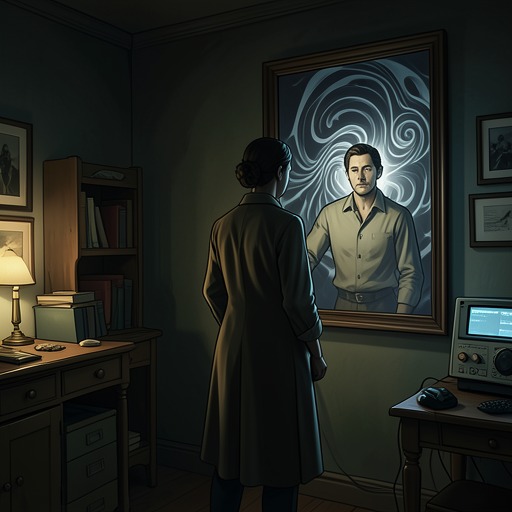
Boothby noticed a relationship between his own response and the unfolding effects of the drug. When the intensity rose and he tensed with anxiety, the scene seemed to tighten. When he deliberately reminded himself to relax and allow the experience to proceed, the change felt dramatic: the already vast space seemed to open still further, and the shapes before him developed more elaborate patterns. He experienced this alternation repeatedly, making surrender a kind of tool for shaping his passage through the journey rather than a principle he understood only afterward.
The experience also had a comic register. On the drive home, with his wife at the wheel, Boothby offered an irreverent description of the overwhelming scale of what he had undergone. That detail sits beside his more solemn account without cancelling it. The same person who could make a joke about the journey could also regard it as a possible mystical experience, one that seemed to open onto an immense reality. The shift in register reflects his persistent irony: intensity did not remove his awareness of how strange, even absurd, its description might sound.
The Crisis and the Collapse of Distinctions
At the depth of the experience, Boothby thought he might be dying or might already be dead. The dependable attachments by which he ordinarily recognized reality had fallen away, leaving him without the usual grounds for dismissing that possibility. Rather than resist the thought, he accepted it as something the experience might require him to face. The episode therefore gives concrete force to the instruction to surrender: it was tested not against a mild disturbance but against the loss of a secure sense of what was happening.
In the most intense phase, categories that ordinarily organize experience seemed to collapse into one another: dreaming and waking, life and death, inner and outer, self and other. Boothby describes reality as folding in on itself, even as the upheaval carried a quality of the sublime. He repeatedly returned to the sense that nothing mattered and that he had seen the point. Then the experience ended. The account records an abrupt limit as well as an extremity: the apparent collapse of his ordinary framework was powerful, but it remains an episode he remembers and interprets afterward, not a permanent state described as continuing without interruption.
From Insight to an Ethic
Boothby’s reflections resist a simple opposition between profound revelation and banal sentiment. He felt embarrassed at times by the apparent content of his insights, which seemed to him to approach familiar, sentimental celebrations of love. Yet he also found the basic insights compelling. The tension is central to his account: the fact that an insight can be expressed in ordinary language does not, for him, settle whether it felt meaningful when experienced.
The clearest lasting formulation concerns relaxation itself. Boothby came to regard the trusting openness he had practiced during the session as pointing toward the purpose of life. He described life’s task as releasing fear and expectations and giving oneself fully to the impact of the present. In this sense, his journey did not leave him with a detailed system of beliefs; it turned a practical response to anxiety into a general discipline. The movement is from a moment-by-moment adjustment within the experience to a principle he could carry beyond it.
Later Reflection and Significance
During a later interview over Sunday brunch at a modern art museum in Baltimore, Boothby spoke with conspicuous enthusiasm about the treasures he had glimpsed at Hopkins. The interviewer also perceived a measure of pity directed toward someone who had not had a comparable hallucinogen experience. Boothby remarked that he did not blame the interviewer for feeling envious. His comment conveys how vivid and valuable the experience remained in his estimation, even as the account’s earlier irony complicates any reading of him as simply credulous or solemn.
Boothby’s significance lies in the way his testimony connects altered perception to conduct. The journey’s striking images and its crisis over death are not presented as separate from the lesson he drew: when fear tightened his response, relaxation opened the experience; afterward, that openness became a way to think about ordinary life. His account also preserves a productive uncertainty. He can describe the episode as mystical and its insights as compelling while recognizing that their verbal form risks sounding trite. That unresolved distance between the felt force of an experience and the plainness of the words used to communicate it is part of what makes his reflection more than a simple endorsement of surrender.